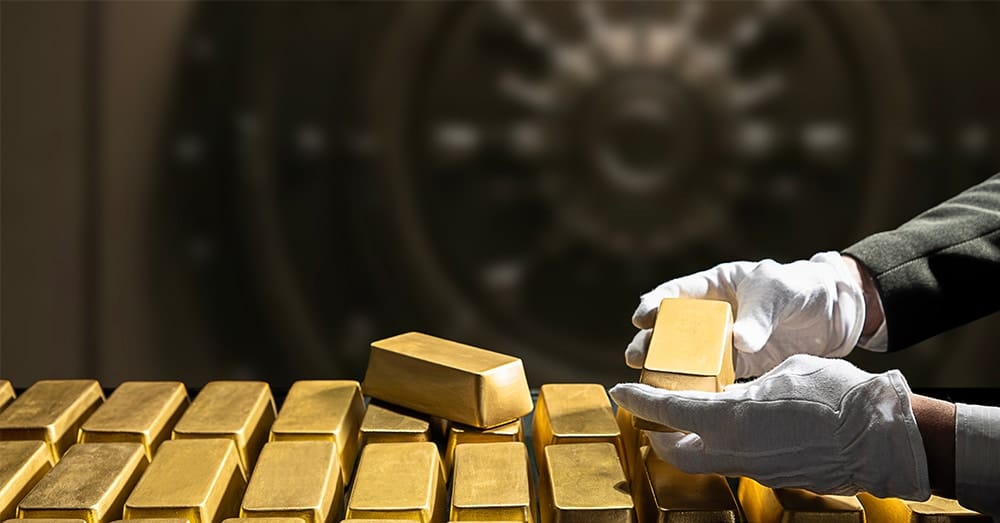
The gold price today, 18 February 2026, stands at around 133,800 euros per kilogramme — or around 4,163 euros per troy ounce. Gold always reacts to what’s happening in the world, and the world is currently giving off quite a few signals. Is and will this precious metal remain a reliable buffer?
Why gold is more relevant now than ever
Gold has something that no other possession has: it has existed for thousands of years as proof of value, and it has never lost its total purchasing power. That is a characteristic you won’t find in any currency, bond or share. In times of economic uncertainty, geopolitical tension or monetary instability, people — from ordinary families to large central banks — seek refuge in the precious metal. Not because the returns are spectacular, but because it provides an anchor when the rest of the financial system falters.
2025 was an exceptional year for gold: the price rose by more than 50 per cent, the strongest return in decades. Central banks worldwide bought gold on a massive scale, partly to become less dependent on the US dollar — a process analysts call “de-dollarisation”. Today, gold accounts for an average of around 25 per cent of global central bank reserves, compared to barely 10 per cent ten years ago. That evolution says something.
I think many people still regard gold as something from another era — something your grandfather kept. But anyone looking today at what’s going on in Europe, in the Middle East, on the Ukrainian border or in trade relations between major powers understands why the precious metal is once again so central.
🔗 Read everything you want to know about gold here
The gold price in 2026: what factors are at play?
A record year that isn’t over yet
In 2025, the gold price reached a new record more than fifty times. At the beginning of 2026, that movement continued. At the end of January, gold officially traded above $1,000 per troy ounce. That was a level that was long considered impossible. Anyone who bought gold at the beginning of 2020 — when the price first climbed above $1,000 — has since more than doubled their investment in dollar value.
What drives that price? Multiple factors play out simultaneously:
- Geopolitical tension: the ongoing conflicts in Ukraine and the Middle East are driving capital towards safe havens.
- Inflation fears: in the US, inflation still fluctuates above 2 per cent, which makes the real interest rate (interest minus inflation) virtually zero or even negative. When saving yields nothing, gold becomes more attractive.
- Central bank purchases: J.P. Morgan estimates that central banks will buy an average of around 755 tonnes of gold in 2026 — a structural demand that supports the market.
- ETF inflows: investors entering gold through funds provide additional demand.
⚱️ Compelling recommendation
Goldman Sachs previously called gold “our most compelling buy recommendation” and expects the price to head towards $1,000 per ounce by the end of 2026. These are not guaranteed predictions, but they indicate how seriously major players are taking the trend.
What do analysts expect for the rest of 2026?
ABN AMRO anticipates stabilisation after a sustained rally at the beginning of 2026. The World Gold Council outlines four scenarios, from sideways movement to an increase of 15 to 30 per cent in the event of an economic recession. There is also a downside scenario: if inflation falls rapidly and the dollar remains strong, a correction of 5 to 20 per cent may occur. Anyone who buys gold expecting to get rich quickly is mistaken. Anyone who regards it as a long-term buffer has historically had little reason to complain: over the past 25 years, the gold price in euros has risen by an average of around 9 per cent per year.
How do you buy physical gold?
Bars or coins: what do you choose?
Anyone wanting to own physical gold faces an initial choice: bars or coins. In practice, it makes little difference to the core value — gold remains gold — but there are nuances.
Gold bars are generally somewhat cheaper per gramme, especially in larger formats. They are produced by recognised refineries and often carry LBMA certification (London Bullion Market Association), which guarantees worldwide tradeability. Common weights range from 1 gramme to 1 kilogramme, with the most traded sizes around 10, 20 or 100 grammes.
Gold coins such as the Krugerrand (South Africa), the Maple Leaf (Canada), the Philharmoniker (Austria) or the American Eagle (US) are internationally recognised and easy to trade — from a gold dealer in Amsterdam to a currency exchange in Bangkok. They are slightly more expensive per gramme than bars, but offer more flexibility when selling in smaller quantities. In crisis situations, small, recognisable coins are more practical than a large bar that you cannot simply divide into pieces.
Where do you buy reliable gold?
Never buy through unknown platforms, social media or suppliers without a hallmark. Reliable dealers are transparent about their prices, have a physical address and offer gold with clear certification. Check whether the gold is provided with an LBMA hallmark or a certificate of authenticity with serial number. Also compare the so-called premium — the amount above the spot price that you pay for production and distribution. This varies by supplier and by format.
Storing gold
This is the part that people most often underestimate. Once you have physical gold in your hands, you also bear responsibility for its storage. There are three common options, each with their own advantages and disadvantages.
Storing at home
Storing at home gives you maximum control and direct access — even when banks are closed, power outages prevail or other situations throw a spanner in the works. That is precisely why many people who think in terms of self-sufficiency keep part of their gold at home.
The risks are real: burglary, fire, water damage. An ordinary household safe offers little protection against experienced burglars. Anyone choosing home storage would do well to invest in a heavy, anchored safe with EN 1143-1 certification (burglary resistance) and fire coverage. A wall safe or floor safe that is not visible significantly reduces the risk. Also always register with your contents insurance and check whether gold is covered — not all policies cover precious metal as standard.
One practical rule of thumb: tell as few people as possible that you have gold at home.
Bank vault or safe deposit box
A bank vault or a private vault facility (such as De Nederlandse Kluis) offers a higher level of security. Your gold remains your property, separate from the bank. Disadvantage: you are dependent on opening hours. In extreme crisis situations — think of the days after 9/11 or the bank closures in Greece in 2015 — access to a bank vault was temporarily impossible. That is precisely the scenario that some people want to avoid by keeping a reserve at home.
Gold as part of a broader strategy
Don’t put everything into one metal
Gold is a store of value, not a profit machine. Anyone who expects the price to always rise forgets that corrections also occur. Between 2013 and 2018, gold lost more than 30 per cent of its value in dollars before rising again. Anyone who sells in panic during a dip misses the point: gold functions as insurance, not as speculation.
A sensible diversification takes into account multiple forms of value: in addition to gold, possibly silver (cheaper per unit, but watch out for VAT), cash reserves, food supplies and other tangible assets. Anyone who only focuses on gold lacks flexibility. Anyone who has no gold at all has no safety net outside the financial system.
Small steps work too
You don’t have to buy a kilo of gold straight away. A gold coin of 1/10 troy ounce or a mini-bar of 1 gramme are excellent entry levels to begin with. Through a method of staggered purchases — a small amount each month — you avoid the risk of poor timing and gradually build up a position. That is an approach that is also feasible for people with a limited budget.
🔗 Buying gold? Without these documents it’s worth less
Closing thoughts
Gold is not a miracle cure and no guarantee of wealth. But those who understand why the precious metal has retained its value for centuries — scarcity, universal recognition, no dependence on banks or governments — also understand why it occupies a logical place in thoughtful preparation for uncertain times. Today’s gold price reflects a world that is increasingly demanding tangible certainties. Whether that trend continues, no one knows. But the question of whether or not you take it into account is certainly one worth considering.