
Gold has been both a reliable means of payment and a store of value since early antiquity. At the same time, the gold price also reacts to global signals – which partly explains why the precious metal is traded at record prices today. But is it also something for you? Why could that be useful? And how do you get started with it?
The seventh James Bond film and immediately the last official Bond film with Sean Connery is called ‘Diamonds are forever‘. Today – in the year 2026 – that seems increasingly less true (in value). The enormous supply and production of artificial diamonds – which look better and better – is depressing prices.
Gold, on the other hand, does not face the same threat. On the contrary: the same amount of gold today still buys roughly the same value of goods as in Roman times.
Why gold?
That historical fact immediately says a great deal about the primary benefit of gold. Gold is forever. Whatever happens: illness, war, political disintegration… Gold retains its value. In fact: when uncertainty increases, the value of gold increases. Gold is thus the ultimate ‘hedge’ par excellence: insurance without a broker. If hyperinflation comes – whereby classical fiat money becomes virtually worthless – or confidence in the banking system collapses, or something even worse… then you can always rely on gold.
Gold also has no counterparty. Your money in your savings account depends on the state and your bank. Shares depend on the management in question. Bonds are debt instruments linked to the issuers… Gold has only one master: the owner in question.
However, a secondary benefit is often overlooked: gold can also be used to protect your investments and as dry powder that becomes ever more powerful as the stock market becomes weaker. Suppose: the stock markets crash by 20-30 per cent. It is quite possible that gold in the months after that crash appreciates by a similar percentage. That happened during the financial crisis of 2008.
It is not always the case that gold mirrors exactly 1 to 1 inversely with the value of shares, but they have an anti-correlation anyway. So you can use that to your advantage to protect your portfolio and even expand it advantageously. If the stock markets crash, you can calmly liquidate gold and convert it into cheap shares.
🔗 discover everything about gold here
How do you get started?
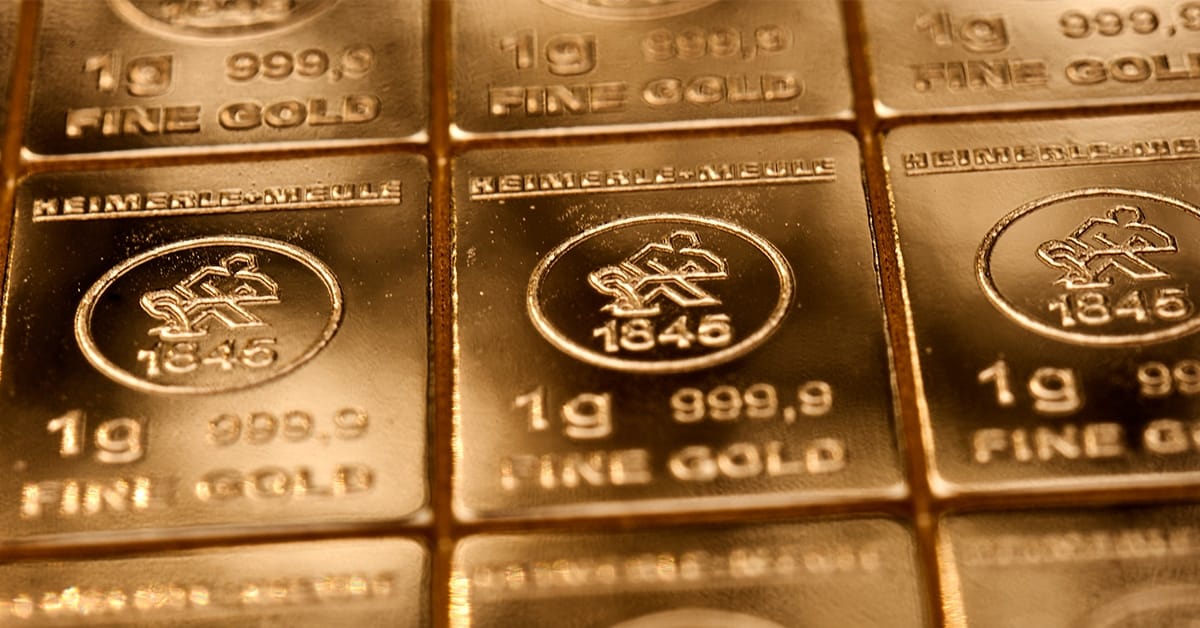
There are several ways to hold gold. And the intended purpose will determine which method you prefer. Do you want to hold gold as a ‘hedge’ against uncertainty, hyperinflation or the implosion of the system? Then it is best to go for physical gold. That can be in gold bars – generally slightly cheaper per gramme – or in gold coins such as the Krugerrand (South Africa) or the American Eagle (USA). You can buy physical gold at, for example, goudwisselkantoor.be. A certificate of authenticity is recommended for physical gold.
However, if you want to go for capital protection, or even for opportunistic and contrarian capital expansion during stock market crashes, then it is best to go for a gold ETC such as that from Invesco or Amundi. Just like a share ETF, an ETC is an exchange-traded fund, but instead of shares there are ‘commodities’ in the fund. In a gold ETC, that ‘commodity’ is of course gold. Gold ETCs can be easily bought through your broker such as Degiro, Mexem or Bolero, but also often through your bank. Simply create an account and order your desired quantity of ETC gold.
Does the stock market collapse? Then you can calmly wait and watch your gold ETC appreciate. If desired, you can then sell it wholly or partially and convert it into ‘bargains’ on the stock market when there is proverbial blood in the streets.

Disadvantages and risks
No asset class is of course without risk. Physical gold has no counterparty once in your possession. But you can lose it. It can be stolen and you have to pay VAT on gold bars (but not on coins). Moreover, it is not super-liquid. Yes, in drastic crises you will be able to pay with gold in many places, but today you must not try it in the supermarket. Physical selling is of course always possible, but not always at the most favourable prices – certainly not in the specialised offices.
ETC gold, on the other hand, is very liquid and immediately tradable – often at the best possible price. But an ETC does have a counterparty, namely the issuer of the fund. Therefore, choose a ‘physical’ ETC, then the gold is also actually physically purchased and it is stored; sometimes even with a physical delivery option such as with Xetra-Gold. Moreover, an ETC has no VAT, but does have a (relatively manageable) stock exchange tax on purchase of 0.35 per cent. (from 2026 there is also a capital gains tax of 10 per cent on capital gains higher than 100,000 EUR under the De Wever government. This is conditionally applicable to both physical gold and ETC gold.)
In short: something for everyone – but you do need to know what you want. Do you want to ‘prep’ yourself against a disaster or societal implosion? Go for physical gold. Are you anticipating a stock market crash and do you possibly want to profit from it? Go for ETC gold.
Nothing or no one says that you cannot have both, of course.