

During the drier summer months, wildfires occur regularly. Whether they are started deliberately, as happened at the end of May 2025 on the Mechelse Heide, or not, as with other wildfires: suddenly you can find yourself in a dangerous situation. That’s why we discuss what you should do if you find yourself in or near a wildfire.
On the Mechelse Heide, an estimated 75 hectares of nature reserve recently burnt down. Because the fire mainly occurred on the flat heathland, no forests were burnt and the heath area will recover within a few weeks.
Casualties
Most mammals were able to escape because they could smell the fire, but many ground-nesting birds such as the woodlark, the skylark, the nightjar and the tree pipit will have had to leave their young behind in the flames.

No people
When the fire broke out, code red for wildfires had been in force in the nature reserves for some time. For safety reasons, access to nature and forest areas is then discouraged. In some places it is even forbidden to enter nature reserves during severe drought. People are then asked not to smoke, not to make fires and certainly not to leave glass bottles near nature and forest areas.
And if you’re there anyway?
Fortunately, no one was endangered during the forest fire in Belgium. Just as well, because the forest fires in Los Angeles made clear how devastating wildfires can be. At the beginning of 2025, at least 30 people died during the forest fires.
What if you are in the forests or on the heath during a wildfire? Or if you accidentally cause one yourself? Then you’d better know a number of extinguishing methods and you need to know how fire moves. This can literally mean the difference between life and death. The professional fire brigade is equipped to tackle large wildfires. But situations can also arise where you have to take action yourself.
Extinguishing a wildfire
Tackling small fire sources
You can sometimes still control a starting forest fire yourself if you act quickly and have the right resources.
Water remains the most effective extinguishing agent
- Spray the water in a wide fan, not in one stream
- Mik op de basis van de vlammen, niet op de toppen
- This cools the fuel and prevents reignition
Soil or sand also work well for smaller fires
- Shovel the sand onto the fire and over the glowing remains
- Stamp it down to cut off the oxygen supply
Large fires
You should never try to extinguish a large wildfire yourself. When the flames are higher than yourself or when the fire is spreading rapidly, there is only one correct solution: get yourself and anyone with you to safety. The heat can injure you at distances of tens of metres, and toxic smoke gases pose a deadly danger.
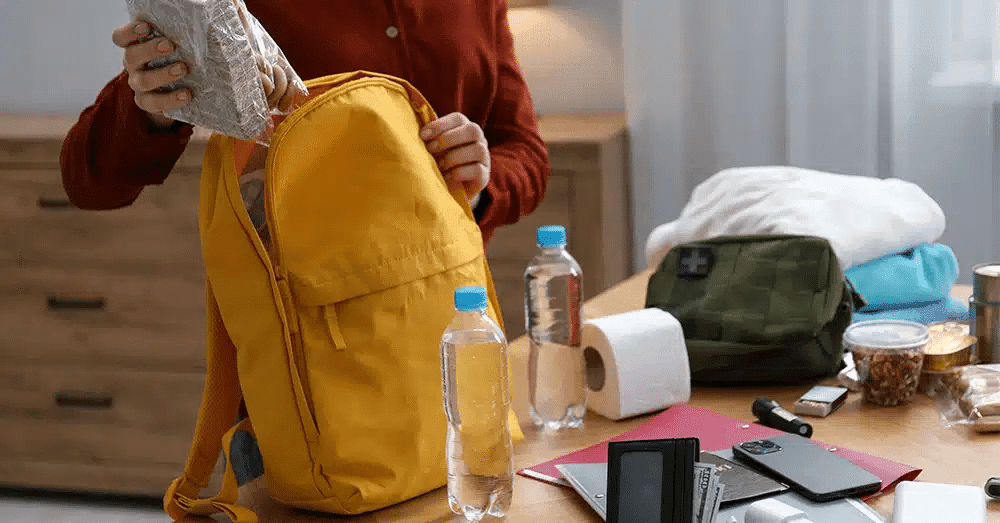
Prepare evacuation routes and know alternatives. Always keep your car at least half full – petrol stations often close first during emergency situations.
Want to know more about what to do in emergency situations? Every week I write a free newsletter about these topics 🔥
Trapped in a wildfire: what works and what doesn’t
What you mustn’t do
Many people make fatal mistakes when they are suddenly surrounded by fire.
- Running uphill seems logical, but fire spreads faster upwards
- Don’t get in your car unless you can drive away safely
- Don’t climb trees
- Don’t shelter in caves or other enclosed spaces
What you can do
- Zoek open, kale gebieden zonder brandbare vegetatie
- Roads, car parks, rocky areas or already burnt terrain
- As a last resort, you can look for a stream or pond
- Stay low to the ground: the air is less polluted there
- Cover your mouth and nose with a damp cloth
- Try to walk into the wind if possible
What you need to have at home
During large wildfires, your own home can also be in danger. That’s why it’s important to have some basic necessities at home.
Basic extinguishing agents
Every home needs basic extinguishing agents.
- Een tuinslang met sproeikop
- Ensure sufficient water pressure and reach around your house.
- Draagbare brandblussers
- Buy ones for outdoor use with foam – they are more effective against vegetation fires.
- Firefighters still use wet jute sacks to combat grass fires.
Water, oh so important!
To extinguish a large fire, you need water. Swimming pools, water butts or underground tanks can be lifesaving.
Want to know more about water?
We’ve already written quite a few articles about water. Read more here about everything to do with water.