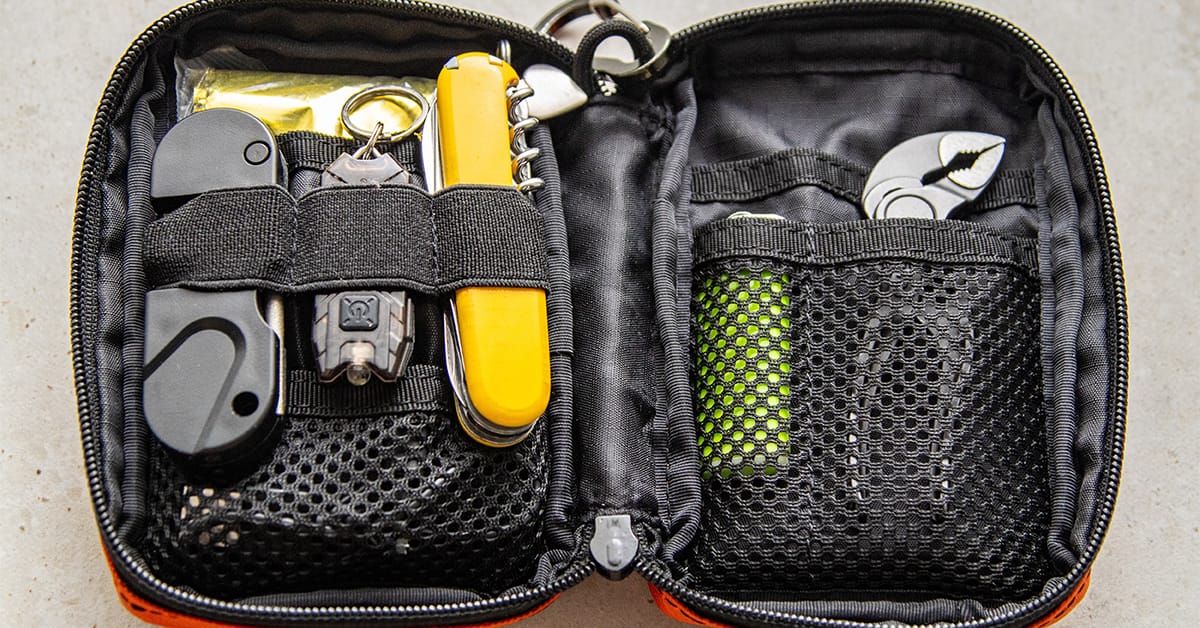


Both European and national governments have been increasingly emphasising in recent months the importance of personal preparation for disasters, wars and other emergencies. Various countries are launching campaigns to encourage citizens to have an emergency kit at home, and governments are providing practical tips to their populations. Below is an overview.
Inhoudstafel
Belgium: “We no longer live in the peace we hoped for”
According to the National Crisis Centre, society is constantly confronted with risks. By taking preventive measures in advance and increasing resilience, the impact of an emergency can be limited, and every citizen can contribute to this.
In October 2024, the Crisis Centre published a three-yearly national risk analysis. It determines in a scientific and structured manner the greatest risks to which Belgium may be exposed. The analysis examines 118 risks from seven categories. According to the report, ‘man-made’ risks are the most likely. This relates not only to terrorism, but also to geopolitical tensions and influence strategies. Consider disinformation campaigns, espionage and hacking. Scenarios with a very high societal impact, but with a low probability, are also examined. Consider a national power cut or a disruption in aviation.
“Resilience of the population and infrastructure against various risks has meanwhile become a key concept for society”, the report states. “The aim is to strive for a more resilient Belgium. This is not only a necessity for us, but for the entire European Union.”
Large-scale campaign
During 2025, the National Crisis Centre will therefore launch a campaign on how we can prepare for a crisis situation. “We no longer live in the peace we hoped for”, said then Minister of the Interior Annelies Verlinden (cd&v) about this at the end of 2024. “There are geopolitical tensions and the number of natural disasters and cyberattacks is increasing.”
The Crisis Centre will clarify in the campaign how to shelter, evacuate and create your own emergency plan. “It will, for example, cover listing people you need to notify, knowing which emergency numbers you should have with you and considering whether it makes sense to have an emergency battery at home, for instance”, the minister said. “Experience shows that as individuals we can also do quite a bit to be well prepared.”
On the webpage ‘What can you do?‘ the National Crisis Centre already provides some tips that you can use yourself. The government service provides a brief guide on what should be in an emergency kit, how you can prepare and help others, and what you can do if you yourself become a victim of an emergency situation.

The Netherlands: “Everyone is needed”
The Dutch government says that in addition to military readiness, societal resilience must also be increased. “Only then can the Netherlands arm itself against war and crises”, says the Ministry of Defence. “Increasing societal resilience and military readiness not only provides additional defence, but also deters Russia and other adversaries.” The Dutch cabinet has therefore mapped out what is needed to be resilient against military or hybrid threats and who is responsible for this.
The Netherlands indicates that the defence apparatus must be able to count on support from citizens and businesses. Even in conflict situations, the economy must continue to function, possibly in service of the armed forces. Dutch politics is working on legislation to make this possible.
Furthermore, the Dutch cabinet is also working on the development of a resilience task. Not only in terms of defence, because the military also wants more support from society. “In a large-scale conflict, the armed forces operate at full capacity”, the Dutch government explains. “Then there is additional need for food, energy supply and healthcare. The fact is that society and the armed forces must make use of the same scarce resources and people during a conflict.”

European Union: “Providing member states with a framework”
The European Union cannot lag behind in protecting its member states against internal or external risks. To this end, the CER Directive was created at the end of 2022. It relates to the protection of organisations against threats such as terrorism, sabotage and natural disasters. For digital risks to network and information systems, there is a similar directive: NIS2.
The purpose of these directives is to provide member states with a framework in which they must conduct research every four years into risk recognition, mitigation and the development of national strategies. The directive also distinguishes between regional and national risks versus European risks. Such European risks are seen as very important because they concern at least six member states.
Towards citizens, the European Union also provides a great deal of concrete advice via platforms through the European Civil Protection and Humanitarian Aid Operations (ECHO). ECHO is primarily intended for development cooperation, but one can also find guidelines on self-reliance, crisis management and international law there.
United States
The United States has an extensive system of national emergency plans and crisis management. The Federal Emergency Management Agency (FEMA) is responsible for disaster response and emergency assistance within the US. The American government has also set up various initiatives to make citizens aware of risks.
The Ready Campaign from Homeland Security, the government service responsible for National Security, encourages Americans to put together an emergency kit and have an evacuation plan. The government website contains tips for surviving extreme weather conditions, during (forest) fires and power cuts.
Furthermore, there is a strong focus on cybersecurity, as the US is vulnerable to digital attacks. In the context of national defence, the American Department of Defense has developed guidelines to protect infrastructure against attacks from hostile states. Moreover, the US participates in international partnerships, such as NATO and the UN, to address global security threats.

France: Extensive online information
France has a comprehensive national strategy for risk management, led by the Ministère de l’Intérieur. The French government has civil protection plans that cover not only natural disasters, but also hybrid warfare and cyber threats.
The Vigipirate plan, which coordinates counter-terrorism, is one of the most visible initiatives. In addition, there is the Plan ORSEC (Organisation de la Réponse de Sécurité Civile) and the Plan Blanc for emergency situations in healthcare. France also emphasises the role of citizens in national resilience. Through the campaign ‘Réagir en cas d’attaque‘ French people are informed about how to prepare for disasters and attacks.
Eastern European countries
Poland
Poland has strengthened its defence policy in recent years, partly due to the threat from Russia. The Polish Ministry of Defence has focused on modernising the army and expanding the Territorial Defence Force, a reserve force that trains citizens to defend the country in emergencies. In addition, Poland has launched a campaign to encourage citizens to stockpile food supplies and to know what to do in the event of a crisis.
Lithuania
Lithuania, like other Baltic states, has an active resilience strategy. The government distributes guides on how citizens should prepare for a possible attack or crisis. In The Survival Guide, an official government document, Lithuanians are encouraged in an accessible way to assemble an emergency kit and to be aware of disinformation campaigns. Russia’s neighbour even gives citizens tips in case they are ever kidnapped or taken prisoner.