
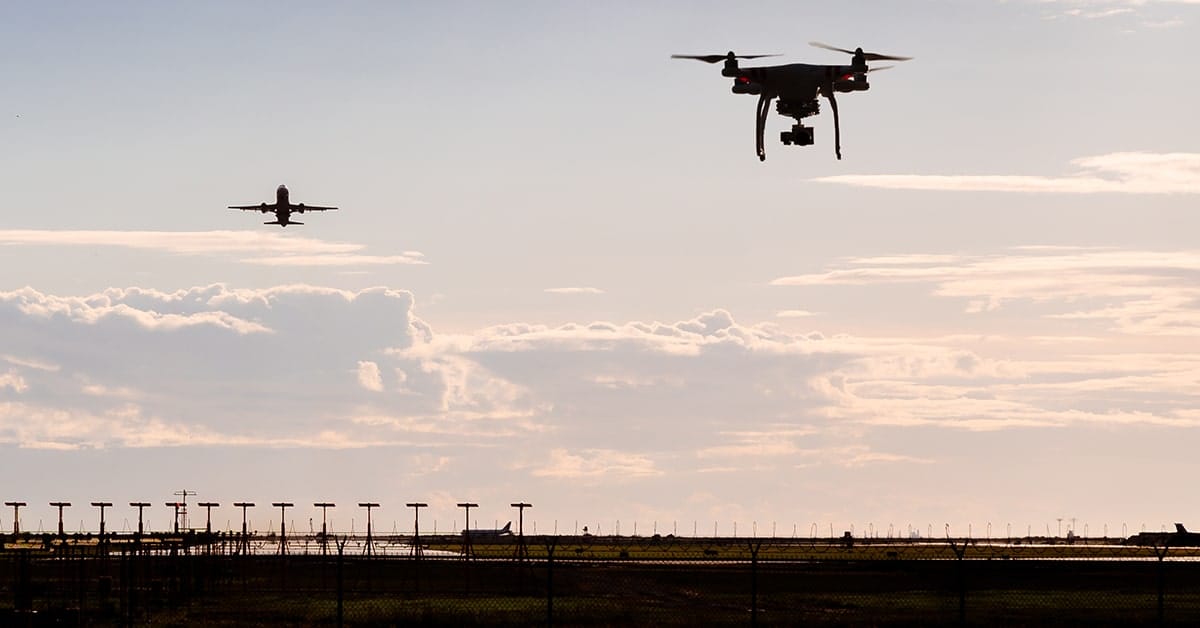
Last week unidentified drones were spotted above the airports of Copenhagen and Oslo. Flights were suspended, radar programmes went into alert mode and authorities spoke of a possible “hybrid conflict” element behind the attacks.
In this article we examine the following:
- What exactly happened?
- Are such disruptions possible at Zaventem or Schiphol?
- What risks does this entail?
- What means can airports deploy to arm themselves against this?
What happened recently with drones above airports?
Dramatic night-time disruptions
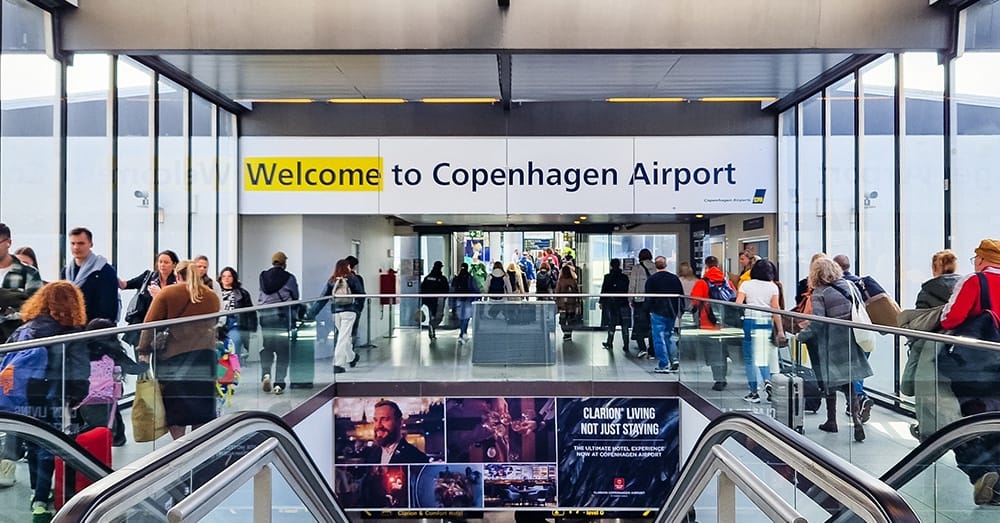
Between 22 and 28 September 2025, several airports in Denmark were temporarily closed or operated with restrictions due to drones flying in controlled airspace.
- Copenhagen Airport was shut down for several hours after multiple drones were repeatedly observed in the airspace.
- Aalborg and other airfields in Jutland reported drone activity and had to delay or redirect flights.
- The Danish authorities described these observations as part of a possible hybrid attack: intended to disrupt, intimidate and test readiness.
In combination with recent cyber-attacks on European airports, a picture emerges of coordinated, multidimensional threats. Authorities are looking particularly at the Russians as potential perpetrators.
Could this also happen at Zaventem or Schiphol?
Comparable vulnerability
The simple answer? Yes, Zaventem and Schiphol are also vulnerable. Schiphol reports tens of thousands of unknown flight movements within its control zone annually, and in Belgium the same applies to the airspace around Zaventem.
Because the airspace is open and drones are relatively easy to deploy, an incident comparable to Denmark cannot be ruled out here. Legal rules also make it difficult to actively bring down drones in civilian areas.
What risks are attached to it?
Safety risks
- Collisions: a drone in an engine can lead to serious damage.
- Disruption of air traffic: sudden appearances cause chaos in communication and coordination.
- Strategic threat: drones can be deployed as an instrument in hybrid warfare.
Operational consequences
- Flights must be diverted or cancelled
- Reputational damage to the airport and airlines
- Higher costs due to delays, fuel and compensation
Delays at the airport? With these power banks your smartphone battery will survive
What can airports and authorities do?
Detection & monitoring
- Radar, RF detection, acoustic sensors and optical cameras
- AI systems that can distinguish between birds and drones
- Cooperation between airports, air traffic control and defence
For emergency situations, redundant communication can be crucial. Alternative networks, such as mesh networks, make it possible to remain operational if conventional connections fail.
Neutralisation techniques
- Jamming and spoofing of signals
- Interceptor drones or net guns
- New technologies such as lasers or microwaves
🔧 This demonstrates the vulnerability of modern infrastructure. In that light, it is useful to consider broader questions: What if the internet and traditional communication no longer work?
Organisation & society
- Developed crisis scenarios and training exercises
- A clear legal framework for rapid interventions
- Cooperation at EU level, such as the idea of a joint “drone wall”
In a broader sense, society itself can also contribute to resilience. The establishment of volunteer corps demonstrates that citizens can play a role in security structures.
Conclusion
The recent drone invasions above European airports are a signal that airports are vulnerable to new forms of disruption. Zaventem and Schiphol cannot be immune to this either.
The solution lies in a combination of technology, organisation and societal resilience. From multilayer detection to alternative communication methods and citizen initiatives — it is about ensuring that critical infrastructure continues to function, even in times of disruption.