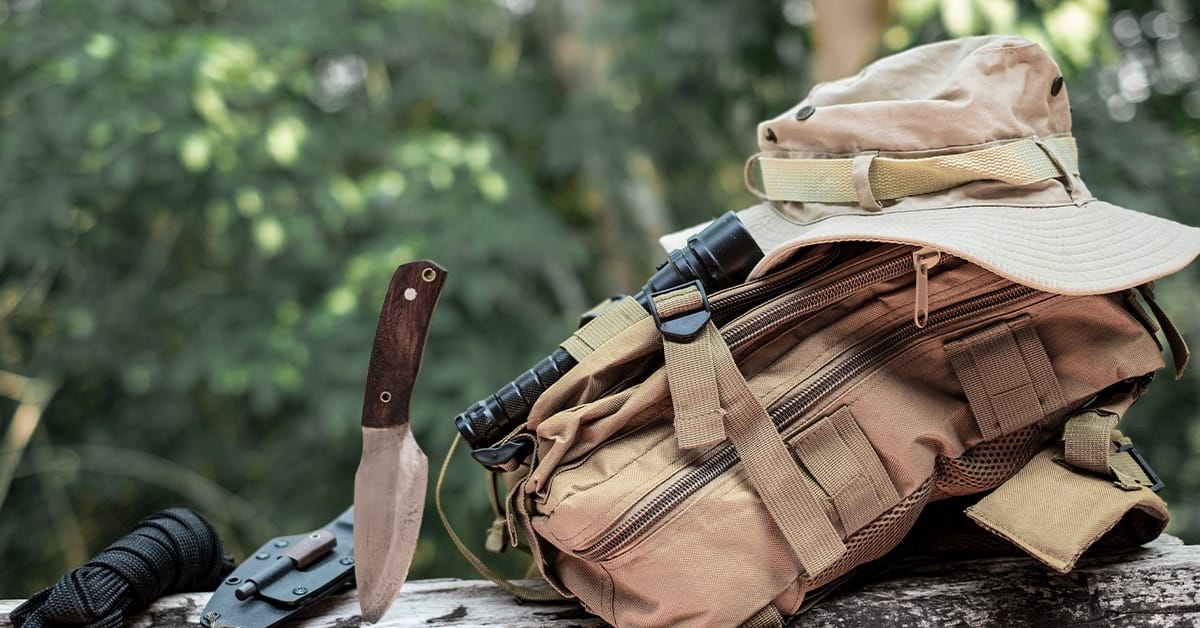
Your head is your first tool in a crisis
Food supplies, emergency packs, water filters — those who want to prepare for an emergency situation mainly think of tangible items. But there is one element that people systematically forget: the mental side of a crisis. How your head reacts to sudden stress, danger or chaos largely determines how you cope. You may have the best equipment at home, but if you freeze or panic at the first setback, that hardly helps.
The psychology behind crisis behaviour is not a woolly domain. The Red Cross, the Belgian National Crisis Centre and numerous research institutes have been emphasising for years that mental preparation is just as essential a part of crisis preparedness as the physical side. The American Psychological Association defines mental resilience as “the process of adapting well to adversity, trauma, tragedy, threats or significant sources of stress.” That sounds abstract, but it is something you can concretely train and deploy.
In this article I look at what happens mentally in an emergency situation, why some people react better than others, and what you can do about it yourself.
What happens in your brain during a crisis
Fight, flight, freeze: the primitive brain takes over
As soon as your brain perceives a threat, your body switches into automatic mode. The amygdala — a small structure deep in your brain — signals danger and activates the autonomic nervous system. This causes an accelerated heart rate, tense muscles and narrowed attention. Your body prepares itself for one of three responses: fight, flight or freeze.
These three responses all have the same biological purpose: survival. In practice they look like this:
- Fight — you go on the attack, become sharp, alert or aggressive
- Flight — you want to leave, avoid the situation, withdraw
- Freeze — you freeze, block, are temporarily unable to act or decide
None of these responses is inherently wrong. They are evolutionarily useful. The problem is that our brain makes no distinction between a predator and a flood, a burglary or a prolonged power cut. It responds to threat signals, not to the nature of the threat.
Tunnel vision and indecisiveness
During acute stress your focus narrows. That is useful if you need to quickly get out of a burning building, but it makes broad decision-making more difficult. You see fewer options, process information more slowly and tend towards impulsive choices. A freeze response feels from the outside like passivity or uncertainty, but it is simply an automatic protective mechanism. Those who understand that can also deal with it.
Info: Research by the American Psychological Association shows that 62% of people communicate less effectively in stressful situations. In an emergency situation, good communication — with housemates, neighbours or emergency services — is precisely crucial.
Why one person reacts better than another
Resilience is not innate
There is a misconception that some people naturally remain calm under pressure and others do not. The Belgian psychologist Michael Portzky, who has conducted extensive research into mental resilience, states that this resilience is more developed in one person than in another — but that it is about development, not an innate characteristic. You can become more resilient. That is an encouraging thought.
Neuropsychological research shows that there are four brain regions associated with resilience. The more active these regions, the better someone deals with stress. The connection between the prefrontal cortex (rational thinking) and the amygdala (alarm) plays a key role in this. Those who strengthen this connection maintain calm more easily in a crisis situation.
Preparation lowers the threshold of fear
One of the most underestimated factors is simply: knowing what to do. Those who have a plan — even if it is a simple evacuation scheme or an agreed meeting point with the family — experience less panic when it comes to it. Muscle memory takes over where conscious decisions are too slow. Those who practise an emergency procedure also act on it.
The National Crisis Centre does not advise without reason to make an emergency plan and maintain that knowledge. Not as an exercise in fear, but as an investment in peace of mind.
🔗 quickly make an emergency plan with this online tool
How to prepare yourself mentally
Get to know your own stress pattern
The first step is awareness. How do you normally react to unexpected situations? Are you someone who springs into action, who freezes, or who runs away from the problem? There is no right or wrong answer, but those who know their own reflex can steer it better.
A simple way to practise this: regularly put yourself in mildly stressful situations. Cold showering, taking a class or training that challenges you, consciously seeking out small uncertainties. Not as masochism, but as training for the nervous system.
Breathing as an anchor
One of the most reliable techniques to temper a fight-flight-freeze response is controlled breathing. By breathing slowly and deeply you activate the parasympathetic nervous system, which brings the body back to rest. The technique that soldiers and emergency responders use — also known as “box breathing” or tactical breathing — works as follows:
- Breathe in for 4 seconds
- Hold for 4 seconds
- Breathe out for 4 seconds
- Hold empty for 4 seconds
That sounds simple, and it is. But those who do not know this technique at the moment it is needed, will not reach for it. So practise it in advance.
Focus on what you can influence
During a crisis there is always a part of the situation that is outside your control. A storm, an attack, a power cut — these things happen to you. Those who direct their energy to what they can do function better than those who become paralysed by what they cannot change. That principle — known from the work of Stephen Covey as the circle of influence — is perhaps the most useful mental model for an emergency situation.
Ask yourself the question: what can I do now? Not tomorrow, not when everything is normal, but now. That focus takes you out of the spiral of fear.
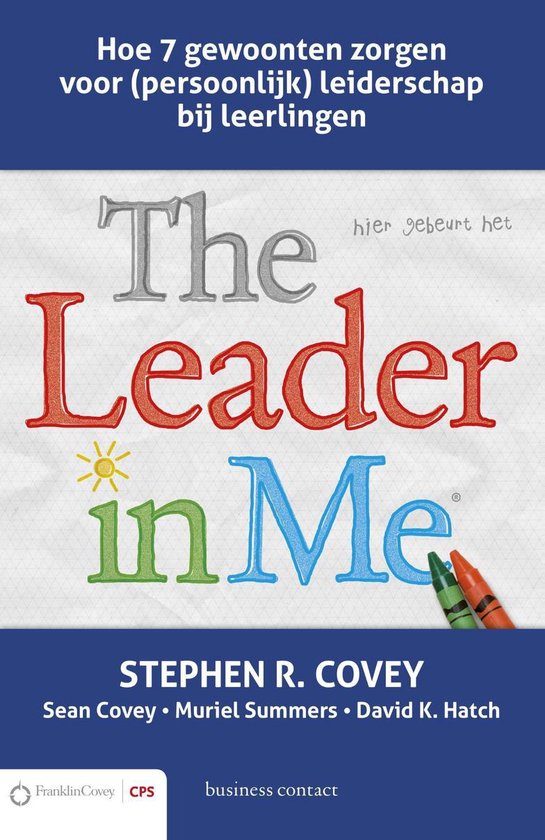
The Leader in Me
The Leader in Me is een procesaanpak gebaseerd op de zeven eigenschappen van effectief leiderschap en betrekt staf, leerlingen en ouders bij het ontwikkelen van de vaardigheden die kinderen in de eenentwintigste eeuw nodig hebben.
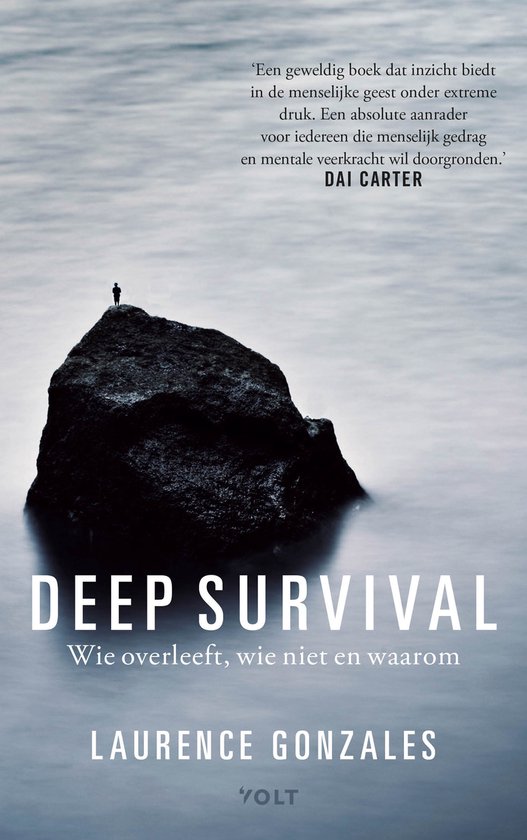
Deep survival
Na een vliegtuigcrash trekt een zeventienjarig meisje elf dagen door de Peruaanse jungle. Tegen alle verwachtingen in, zonder voedsel, onderdak of uitrusting, overleeft ze. Een beter uitgeruste groep volwassenen blijft bij elkaar op de plek van de crash en overleeft het niet. Wat maakt het verschil?
Routines and structure as support
In chaos people seek support. Routines — even small ones — give structure to a disrupted world. Those who during a prolonged crisis hold on to fixed eating and sleeping times, exercise regularly and consciously build in breaks, maintain their cognitive capacities better. It sounds trivial, but the mental exhaustion during prolonged stress often does not come from the crisis itself, but from the lack of rhythm and recovery time.
🎙️ Stress can also be useful
Short-term stress is physiologically normal and even useful. It only becomes a problem when that stress persists without recovery periods. Prolonged elevated cortisol and adrenaline levels lead to exhaustion, sleep problems and impaired judgement — precisely what you do not want in a crisis situation.
Has stress already helped you at some moments? Let us know in the comments below?
Meaning and direction
Mental resilience is not only about staying calm. It is also about maintaining direction. Those who have a clear goal — the safety of my family, helping my neighbours, controlling the situation — continue to function better than those who react aimlessly. This applies to individuals and to groups. Teams that consist of loose sand and have no shared values collapse under crisis. Families and communities with mutual bonds and trust stand stronger.
Mental preparation as part of your crisis plan
The difference between panic and calm
The National Crisis Centre states itself: “In an emergency situation, the difference between panic and calm is often the direct result of preparation.” That difference does not lie in character or courage, but in knowledge and training. Those who know what they must do need to make fewer decisions in the moment of crisis.
Add a mental component to your preparation as well:
- Discuss possible scenarios with your family, without dramatising them
- Practise your emergency procedure at least once a year
- Learn basic techniques for stress regulation (breathing, grounding)
- Build a social network — isolation increases vulnerability
- Ensure sufficient sleep, exercise and nutrition in normal times. An exhausted body also has an exhausted mind.
Also look at the people around you
A crisis rarely affects only you. Children, elderly people, people with anxieties or trauma react differently and more intensely. Those who prepare themselves mentally also think about who in their surroundings needs extra support. That is not acknowledging weakness, it is realism.
Conclusion
An emergency pack and a good water supply are a start, but your head is your most durable tool. Those who know their own stress reactions, master a few concrete techniques and have discussed their plan with the people around them, stand considerably stronger in a crisis. Mental preparation does not require a large investment — but it does require that you engage with it consciously, before it is necessary. That is perhaps the simplest but most overlooked form of self-reliance.