

You can survive without food for a while, but humans can only last about three days without water. Every day we need approximately 2 to 3 litres to function normally. During heavy exertion or heat, this can rise to more than 6 litres per day.
Safe drinking water
Under normal circumstances, safe drinking water in the Netherlands and Belgium simply comes from the tap. Supermarkets are also full of bottled water. But in unforeseen circumstances such as natural disasters and prolonged power cuts, the water supply can fail.
- Did you know that many water companies use electric pumps to transport water to household pipes?
It may be that nothing comes out of the tap for a while, or that tap water becomes unreliable. That’s why in this article we discuss six different methods by which you can provide yourself with drinking water.
What makes water unsafe?
Invisible threats
Surface water from rivers, canals, lakes and ponds can contain various types of contamination that cannot be seen with the naked eye. So a clear and fresh stream can still contain pathogens. The three main categories are:
- Bacteriën: Zoals E.coli en Salmonella, verantwoordelijk voor ongeveer 75% van alle gevallen van reizigersdiarree.
- This bacterial contamination often occurs due to emergency sewage outlets that discharge untreated sewage water directly into river water during heavy rainfall.
- Viruses: The smallest pathogens, such as rotavirus and hepatitis A and E.
- Protozoa: Single-celled organisms such as Giardia and Cryptosporidium that can cause serious intestinal infections.
In addition, there may also be human contaminants in the water. Think of fertilisers, pesticides, heavy metals and microplastics from, for example, agriculture and industry.
Do you still get infected by a bacterium or virus from river water? Then think of these first aid tips. In this article we go into more detail on the question of how you can safely drink river water.
Method 1: Chemical purification
Water purification tablets and drops
Chemical purification agents such as tablets or drops based on chlorine or chlorine dioxide are compact and easy to use. Well-known brands are Micropur Forte (in powder form) and Aquatabs (in tablet form). Oasis and Hadex water purification drops are also suitable.
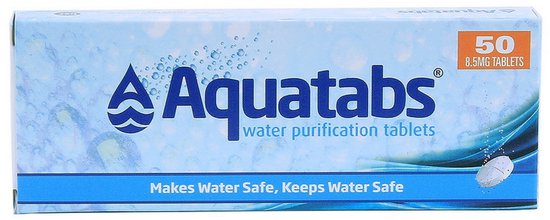
Aquatabs waterzuiveringstabletten 50 stuks
Met Aquatabs waterzuiveringstabletten beschik je in slechts 30 minuten over veilig drinkwater, ideaal voor buitenactiviteiten zoals kamperen of survivaltochten. Deze tabletten elimineren schadelijke micro-organismen, waardoor je met een gerust hart kunt koken of drinken.
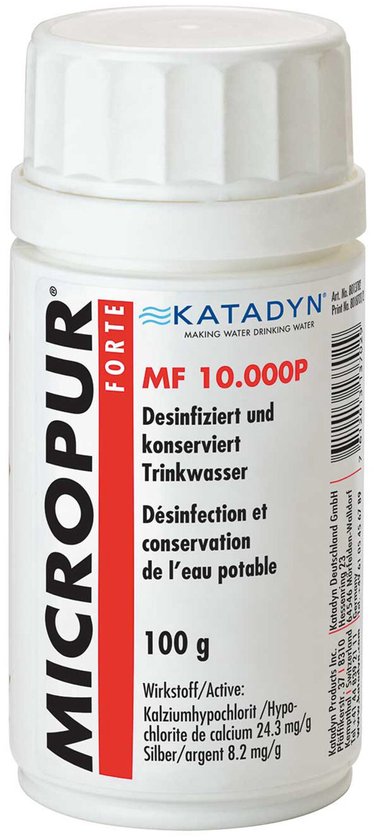
Katadyn Micropur Forte Mf zuiveringspoeder
Met het KATADYN Micropur Forte Mf 10000P zuiveringspoeder kun je op een eenvoudige manier water zuiveren van schadelijke bacteriën en virussen. Dit poeder, dat chloordioxide afgeeft, is ideaal voor buitenactiviteiten zoals kamperen en wandelen. Het heeft geen invloed op de smaak of geur van het water. Een uitstekende keuze voor wie voorbereid wil zijn op onverwachte situaties, zodat schoon drinkwater altijd binnen handbereik is.
Working principle
When using, you add one tablet per litre of water and wait approximately 30 minutes. The chlorine kills everything living in the water, making it safe to drink. Some products have a longer contact time of 1 to 2 hours.
Advantages and disadvantages
Advantages:
- Effective against bacteria, protozoa and viruses
- Light and compact, ideal for on the go
- Long shelf life
- Relatively inexpensive
Disadvantages:
- Does not make water clear (only kills micro-organisms)
- May leave a chlorine taste
- Does not remove chemical contaminants
- Not all products are suitable for pregnant women
❓Want to know more❓
I have previously written several articles about filtering water. Read them below:
Method 2: Boiling water
The basics of water purification
Boiling water is the oldest and most accessible method to make water microbiologically safe. By boiling water for five minutes, all micro-organisms are killed. Sediment and dirt particles do remain in the water.
Advantages and disadvantages
Advantages:
- Effectively kills all pathogenic organisms
- No special equipment needed, only a pan and heat source
- Reliable method under virtually all circumstances
Disadvantages:
- Requires fuel and time
- Water must cool before consumption
- Does not remove chemical contaminants or solid particles
- Not practical for large quantities of water
You don’t need much to boil water in nature: it’s possible even without a cooking pot. You can even boil water in a paper cup! Watch the video below.
Method 3: Mechanical water filters
Different types of mechanical filters
There are different types of mechanical water filters: pump filters, gravity filters and drinking straw filters. With pump filters you manually pump the water through a filter element. With gravity filters you let gravity do the work, and with drinking straw filters you drink the water directly through the filter via a straw.
Filter elements
Most water filters use ceramic or fibreglass filter elements with a certain pore size. Standard water filters remove bacteria, protozoa, cysts (such as Salmonella) and other impurities from the water. Some filters can purify up to 380,000 litres of water.
Advantages and disadvantages
Advantages:
- Immediately drinkable water without waiting time
- Also makes water physically clear
- No chemicals required
- Large filter capacity
Disadvantages:
- Does not remove viruses, chemicals, pesticides or heavy metals (unless combined with activated carbon)
- More expensive to purchase than chemical purification
- Requires maintenance and sometimes replacement of filter elements
Method 4: Water filters with activated carbon
The added value of activated carbon
Water filters based on activated carbon offer more protection than standard mechanical filters. The activated carbon binds heavy metals, chemicals, pesticides and in some cases also viruses.
Applications and operation
These filters are available as portable filter bottles, but also as larger systems. Water flows through a layer of activated carbon that absorbs harmful substances.
Advantages and disadvantages
Advantages:
- Removes viruses, heavy metals, chemicals and pesticides
- Improves taste and odour of the water
- No waiting time
Disadvantages:
- The activated carbon loses its effectiveness over time and must be replaced
- More expensive than standard mechanical filters
- Less suitable for large groups of people due to limited capacity
Method 5: UV water purification
Technological purification
UV water purifiers use ultraviolet light to damage the DNA of micro-organisms. This prevents them from multiplying and making you ill. A well-known model is the Steripen, which can sterilise water in 48-90 seconds. Steripen won the Desnivel Award for new products in 2012 from the Spanish climbing and mountaineering magazine Desnivel.
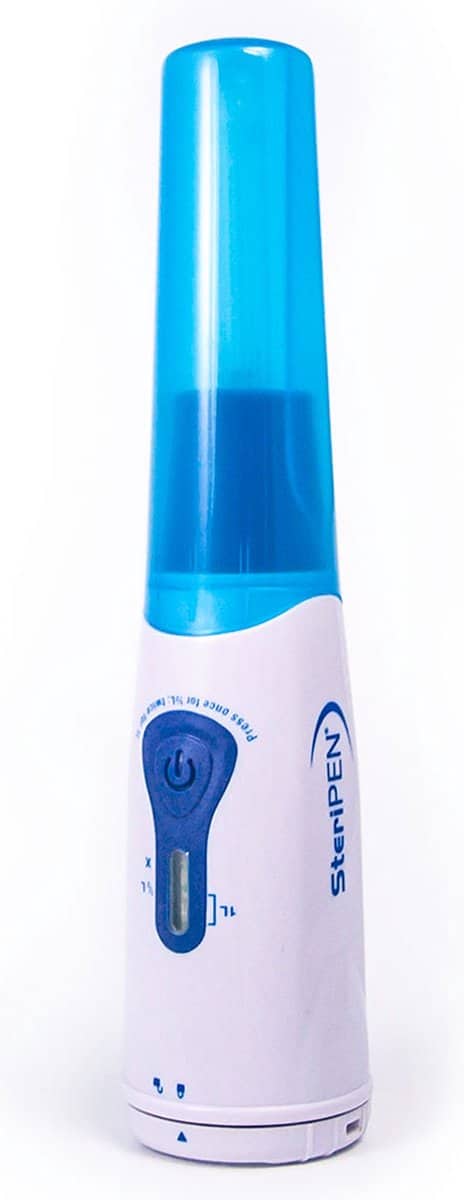
Classic 3 UV-waterzuiveraar
Zuivert water met uv-licht en doodt meer dan 99,9% van bacteriën, virussen en protozoa; ongeveer 90 seconden per liter.
Advantages and disadvantages
Advantages:
- Very effective against bacteria, protozoa and viruses
- Fast acting
- No change in water taste
- No chemicals required
Disadvantages:
- Requires batteries or electricity
- Works less well in murky water (pre-filtering is necessary)
- Does not remove dirt particles or chemical contaminants
- Electronic devices are more susceptible to malfunctions
✉️ Interested in these topics? ✉️
Every week I write a free newsletter about these kinds of topics. Do you want to learn more about survival, self-reliance and how you can prepare yourself for emergencies? Then sign up via this link!
Method 6: Distillation
The most thorough purification method
Distillation is a process whereby water is heated until it evaporates, after which the water vapour is collected and cooled to liquid water. In doing so, virtually all contaminants remain behind, including heavy metals and salt.
Home distillation
In emergency situations you can make a simple distillation system. Place a smaller bowl in a large pot with (contaminated) water. Bring the water to the boil, place an inverted lid on the pot, and let the condensation drip into the smaller bowl.
Advantages and disadvantages
Advantages:
- Removes virtually all contaminants
- Also works for salt water (seawater)
- Very clean end result
- Effective with heavily contaminated water
Disadvantages:
- Very energy-intensive process
- Slow for large quantities of water
- Also removes beneficial minerals
- Requires equipment or thorough improvisation
Storing water
How much water do you need?
Experts advise storing at least 3-4 litres of water per person per day. This amounts to approximately 28 litres per person for a week. To be fully prepared, 9-18 litres per day is recommended, which for a family of four quickly means 240-480 litres for one week.
The Red Cross and the Dutch government recommend having at least 3 litres of water per person per day: 2 litres for drinking and 1 litre for hygiene and cooking. For a three-day emergency, this amounts to 9 litres per person.
How do you store it?
There are different ways to store water:
- Commercially bottled water: Still bottled water has a long shelf life and is immediately ready for use.
- Jerrycans and water barrels: only use food-safe containers that are designed to store drinking water.
- Water storage tanks: For larger quantities of water you can use larger tanks, such as a 1,000 litre IBC container.
- Emergency water sachets: These are compact, pre-packaged water sachets with a long shelf life. They were originally developed for life rafts.

Tips for storing water
Store your water supply in a cool, dark place and not in direct sunlight. Self-stored water should be refreshed every six months, whilst commercial water can sometimes be stored for up to ten years.
Because a chemical taste can develop in plastic bottles over time, many people find glass bottles an alternative that lasts longer.
- Tip: Filling bottles right up to the cap helps to reduce oxygen exposure.
Your food must also be stored safely! I wrote the following articles about this:
Water collection as a supplement
In addition to building up a drinking water supply, it’s also useful to set up systems to collect rainwater. This can be done via drainpipes, with buckets or barrels. Tarpaulins can also be used to collect rainwater. Please note: collected rainwater must always be purified before it is safe to drink.
Saving water
The less water you need when there is scarcity, the better. Don’t wait for an emergency to think of water-saving methods. For example, use ready meals that require little water to prepare, use hand sanitiser to clean hands, and consider disposable plates and cutlery for emergencies when water is scarce.