Why preparation as a parent is extra important
A power cut in the middle of winter. A flood that comes faster than expected. An evacuation where you have to leave your house in a matter of minutes. Those kinds of scenarios are stressful enough for adults, but with children involved, everything changes. Children don’t always understand what’s happening, react more emotionally and are completely dependent on you. That’s why you need to prepare for such situations.
I notice that many parents prefer to avoid the subject. “It won’t happen to us.” But the reality is different. The Dutch NCTV warns that threats are increasing: from extreme weather conditions to cyber attacks on vital infrastructure. The Belgian Crisis Centre launched the campaign ‘Prepared together’ and advises every household to be able to function independently for at least 72 hours. Those with children need to add another layer on top of that. Because an emergency situation with children requires different supplies, different communication and a different approach.
This article helps you as a parent or carer to be prepared. Not from panic, but from level-headedness. Because those who know what to do remain calmer, and children sense that infallibly.
Why children react differently to a crisis
Fear is normal, panic is not
Children process stress differently from adults. Their brains are still developing, which means they are less able to assess situations rationally. A five-year-old doesn’t understand why the water from the tap suddenly stops coming. A teenager may understand, but can become extra anxious precisely because of that.
Psychologists emphasise that a certain degree of fear in children is healthy — it helps them recognise danger. But in a crisis situation, that fear can quickly turn into panic, especially if the child notices that the adults around them are also stressed. Children read emotions incredibly quickly. If you’re nervous, so are they.
Age makes a difference
How a child responds to an emergency situation depends heavily on age.
- Babies and toddlers sense tension through physical contact and tone of voice. They can’t articulate what’s wrong, but cry more, sleep worse and cling on.
- Preschoolers (3-6 years) understand fragments of what’s happening, but fill in the gaps with imagination — which is often more frightening than reality.
- School-age children (6-12 years) ask lots of questions and want to understand what’s going on. They can help practically, but also become restless when they notice that adults don’t have answers.
- Teenagers sometimes seem nonchalant, but process stress internally. They withdraw, become irritable or start acting overly ‘tough’.
💡Did you know that…
children often express stress physically? Stomach ache, headache, nausea or sleep problems. Take these complaints seriously, even if there doesn’t seem to be a medical cause!
A family emergency plan: the foundation you can lay now
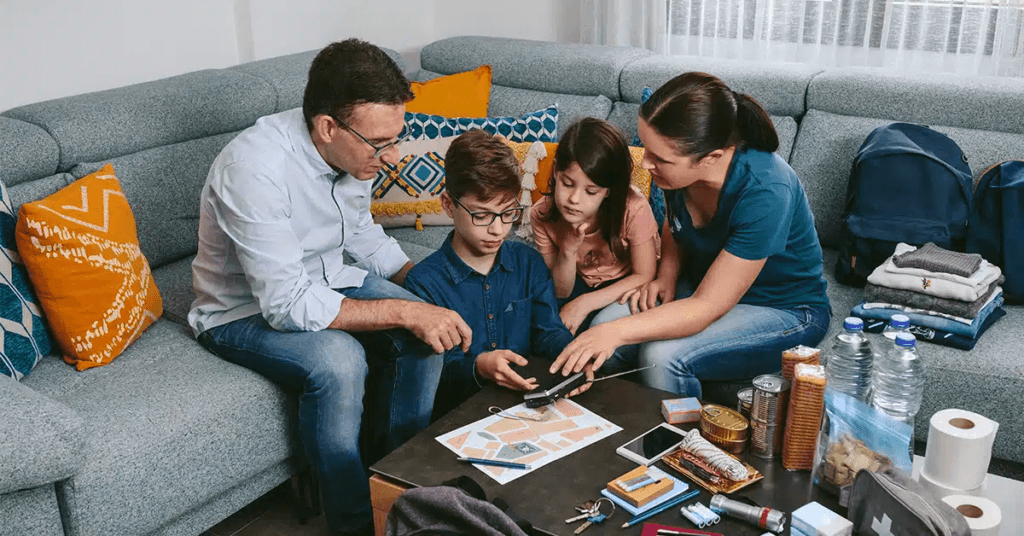
Make the plan together
An emergency plan is not a document you write and put in a drawer. It’s a conversation you have with your family. The Dutch government advises via denkvooruit.nl to make agreements together about what you do if the power fails, if you have to evacuate or if you lose each other. Via this link you can draw up an emergency plan in Belgium.
Involve your children in that conversation, tailored to their age. Let a toddler learn mum or dad’s phone number. Give a school-age child the task of putting together their own rucksack. Let a teenager think along about the escape route. Children who are involved in the preparation feel less powerless when it comes to it.
Agree on a meeting point
Suppose you’re at work and the schools close unexpectedly. Or the phone lines go down. Where will you find each other? Agree on a specific point — a recognisable tree in the street, the neighbours’ house, a community centre. And make sure everyone knows that point, including your children.
Info: The Belgian Crisis Centre has an online tool with which you can draw up a personal emergency plan step by step. You can find it at crisiscentrum.be.
Practise — without sowing fear
Turn a drill into a game. Call it a “secret mission” or an “adventure exercise”. Children love role-playing games. Practise how to leave the house in case of fire, where the torch is, how the emergency radio works. Do this at least twice a year. That way it becomes routine rather than something frightening.
I find it important myself to be honest with children, without overwhelming them. You don’t have to paint doom scenarios. But a child who knows where the first aid kit is and how to dial 999 is already considerably more resilient.
The emergency kit: what changes with children?
The basic list expanded
The government advises everyone to put together an emergency kit that will last you 72 hours. The standard list — water, non-perishable food, torch, first aid kit, emergency radio, cash — applies to every household. But with children, specific items are added:
- Babies: formula or powdered milk, nappies (reckon on at least 8 per day), nappy cream, dummy, bottles
- Toddlers and preschoolers: fruit pouches, crackers, a favourite cuddly toy or dummy, colouring books or small toys
- School-age children: their own torch, a pack of cards or book, a whistle
- Teenagers: a power bank, headphones, their own water bottle
Comfort is not a luxury
In a stressful situation, a familiar object can make all the difference. A cuddly toy, a favourite blanket, a game — it may sound unimportant next to water and food, but for a child it isn’t. Comfort objects provide stability in a world that is suddenly unrecognisable.
Also think about entertainment. An emergency situation with children without any distraction is a recipe for unrest. A pack of cards, a colouring book and some pencils take up hardly any space, but deliver a lot.
Medicines and allergies
If your child needs medication — for asthma, allergies, epilepsy — make sure you always have a supply of at least a week separately. Also note allergies and medication dosages on a laminated card in the emergency kit. During an evacuation you may end up with emergency services who don’t know your child.
🔗 discover everything about first aid here
Staying calm: easier said than done
You are the anchor
Children look at you. Not at the situation, but at your reaction to it. If you react calmly and composedly, it gives them a sense of security — even if the circumstances are far from safe. That doesn’t mean you should suppress your emotions. Children feel the difference between genuine calm and forced cheerfulness.
What helps: describe what’s happening in simple words. “The power has gone out, but we have candles and torches. We’ll manage.” Provide structure, even if that structure is simple — preparing a meal on the camping stove, playing a game together, maintaining a fixed sleep routine.
Breathing as a tool
A simple technique that works for both adults and children: breathe in deeply together and exhale slowly. Make a game of it — “we’re blowing up a big balloon.” Breathing exercises activate the parasympathetic nervous system and help reduce the stress response. Sounds simple, and it is.
Listen and acknowledge
Ask your child how they feel. Not once, but regularly. And if they say they’re scared, don’t say “you don’t need to be” — because for the child that fear is very real. Rather say: “I understand that you’re scared. I’m with you and I’ll look after you.” That acknowledgement is more powerful than any distraction manoeuvre.
Evacuation with children: practical considerations
Have the emergency bag ready
A well-prepared emergency bag is kept in a fixed, accessible place in the house. For families with children, it’s useful to have a separate rucksack ready for each child, containing their own torch, a snack, a cuddly toy and a whistle. Children carrying their own bag feel involved rather than helpless.
Ensure that the main bag contains the documents: copies of identity cards, the yellow booklet (vaccination record), insurance details and a list of telephone numbers on paper. In a digital world we quickly forget that phones can run out of battery.
In the car
If you need to evacuate by car, make sure that your car seats are always in order. Keep a small emergency supply in the car: water, energy bars, a blanket, a torch. Children quickly become restless in a traffic jam or on an unfamiliar route — an audiobook or music can help.
On foot or by public transport
When evacuating on foot with small children, a sling or carrier for babies and toddlers is essential. A buggy is often awkward on uneven terrain or in crowds. Agree who carries which child and swap regularly.
What if you become separated from your children?
This is every parent’s nightmare, but it can happen. You’re at work when something occurs. The school is evacuated. The phone doesn’t work.
Agree in advance:
- Who will collect the children if you can’t? A grandparent, neighbour, friend?
- Does the school know this person and are they authorised to take your children?
- Do your children know who to go to if they can’t reach you?
Schools and nurseries usually have their own emergency plans. Ask about them and make sure your contact details are up to date. A card in your child’s coat pocket with name, address and telephone number of two contact persons is a small effort.
Involving children in self-reliance
Age-appropriate skills
Self-reliance isn’t learnt at the moment things go wrong. These are skills that you gradually build up, including with children:
- From 4 years: know mummy or daddy’s telephone number, know where the torch is
- From 6 years: be able to call 999 and clearly state their name and address
- From 8 years: read a simple compass or map, help with preparing the emergency kit
- From 10 years: basic first aid knowledge (apply a plaster, know what the recovery position is)
- From 12 years: independently purify water, make a fire under supervision, operate a camping stove
Make it fun, not oppressive
Camping is an excellent way to familiarise children with basic skills. Living without electricity, cooking outdoors, finding your way with a torch — it’s exciting and educational at the same time. That doesn’t have to be in the wilderness; a weekend in the garden with a tent works wonders.
I think we underestimate children in what they can handle. A child who learns to make a fire or filter water doesn’t just gain a skill — they gain confidence in themselves. And that is perhaps the most valuable preparation you can give as a parent.
After the crisis: don’t forget processing
An emergency situation leaves traces, even with children who have seemingly dealt well with the situation. In the weeks following a traumatic experience, children may display regressive behaviour — bedwetting again, becoming clingy, having nightmares. That’s normal and usually temporary.
Talk about it, but don’t force it. Let children draw what they’ve experienced, or tell a story about it. Restore the daily routine as quickly as possible — structure provides security. And watch out for symptoms that persist for longer than a few weeks. In that case, professional help may be useful.
Preparation is not fear, it is responsibility
Finding yourself in an emergency situation with children is something no parent wants. But denying the possibility doesn’t make you less vulnerable — it only makes you less prepared. A family emergency plan, an adapted emergency kit and a few basic skills completely change the dynamics. Not because you’re afraid, but because you’re taking responsibility. And perhaps even more importantly: you teach your children that they’re not powerless. That they can do something. And that is a lesson that extends far beyond the emergency situation.