“I help myself” was a series of booklets that were published during World War I or II. One title was “Breeding rabbits in wartime”, written by K. Verhasselt, engineer, agronomist, official lecturer on rabbit breeding. A scan of the booklet can be found via this link.
It states that it was extremely difficult to obtain meat at the time. They recommended rabbits for breeding because they are not fussy about their food, you can breed them easily and they only need a simple and hygienic hutch. You can also earn a bit of money by selling their fur. It describes how to slaughter a rabbit and remove the pelt. The booklet also explains how to make a rabbit hutch for breeding.
- Slaughtering a rabbit the modern way? Read here how to do it!
World War I
During the First World War, the population in Belgium was even encouraged by the Germans to breed rabbits. They did this through posters. Rabbit hutches are not large (for breeding anyway) and you can place them in your garden or indoors. They can be slaughtered at 10 to 12 weeks old. Then they weigh approximately 2.5 kilos. The does have 4 to 8 young per litter. She nurses her young for four to five weeks which are then fattened. They are sexually mature after 3 to 4 months, but for the health of the rabbit it is better to breed them only after 9 months. Healthier does also produce healthier young.
💡 Did you know that you are allowed to slaughter rabbits at home yourself: FAQ home slaughter | Federal Agency for the Safety of the Food Chain
Which breed is suitable as a meat rabbit?
In any case, you certainly must not use rabbits that are sold in ordinary pet shops. They must be pedigree rabbits. The first rabbits you purchase must not be related to each other in order to avoid inbreeding as much as possible. You can also occasionally exchange rabbits with other people to avoid inbreeding, because through inbreeding they become infertile and then you can no longer breed with them.
In the booklet from during the War, the Flemish Giant is recommended, but according to others it is less suitable, because even though they are large rabbits, they are tough and therefore only good for the casserole. They take up a lot of space and need more food. Of course, they do weigh more than an ordinary rabbit. The White New Zealand is the best choice because of their high fertility. You do need to have plenty of grass available.
Other breeds? Discover them here 👉 Gogreenbuddy » The right meat rabbits to breed
If you want to breed rabbits, then you have no choice but to keep the rabbits separate (which the rabbits do not enjoy). And to fertilise them you can put them together briefly (less simple though than it sounds). You must prepare yourself well so that you know how many times you want your doe to give birth, because you do not want to end up with too many rabbits.
Caring for rabbits
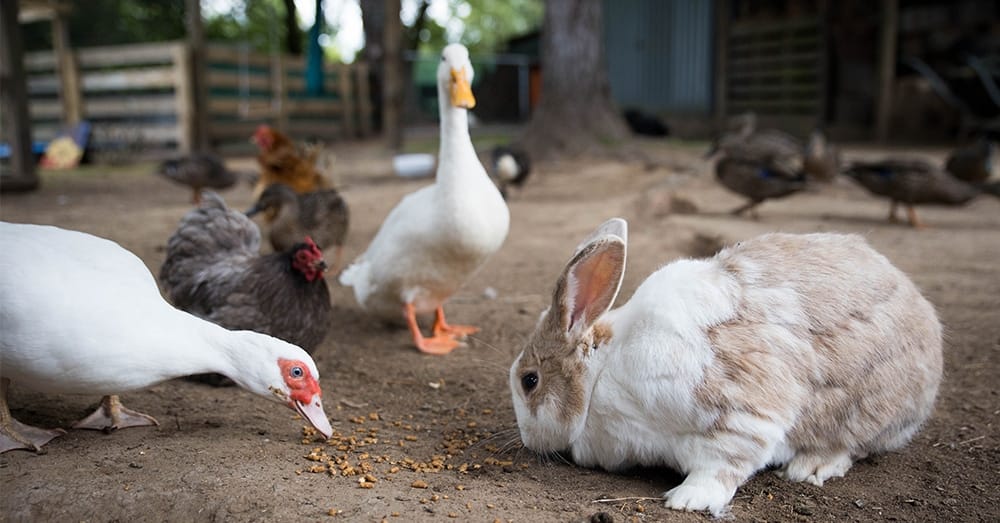
You must care for your rabbits very well so that they do not become ill. If you keep rabbits, then it is recommended to give them mainly hay (90 per cent – as much as they are large), a very small amount of pellets (boring sticks – one type of pellet in which everything is mixed together, because rabbits are fussy and it may be that they do not eat some of them and then you lose useful food) and limited greens (too much greens gives them diarrhoea). Hay and pellets are dry, so you can store them longer. Hay does lose its nutritional value after a while. Every day they need fresh water. They are crepuscular animals, so you can best feed them in the morning and evening. They also enjoy eating freshly picked grass and dandelions.
In times of scarcity you can feed them cheaply with freshly picked grass, dandelions, clover, vegetable scraps and tops. They eat everything you give them, including poisonous plants. So you can best look up which vegetables and herbs they may eat, because cabbage and lettuce, for example, they must not eat. Their hutch must certainly be cleaned out every week so that they cannot become ill.
Rabbit with cherries, plums or raisins
Rabbit meat contains 22 grams of protein and 5 grams of fat per 100 grams. It is lean meat, so eating only rabbit meat is not sufficient to live on. But you can add a lot of fat when preparing it. Do not forget that eating sufficient fat and protein is more important than carbohydrates.
Rabbit is very suitable for stewing in a closed pot with a lid on a low heat. Actually, that is a hotchpotch, could not be more Flemish. It does take longer, but you only need one fire. It also seems less work to me: cut everything such as onions, carrots, beer, dried plums, thyme,… and just throw everything into the pot. Some beers keep for a long time, so handy to stock some as well.
In the recipes with plums they always use dried plums, but perhaps you can also add them from a tin or jar instead. Or you choose to add cherries from a jar. Or raisins.
Many possibilities to consider and you can certainly gain even more inspiration from a distant past to prepare yourself for the future!