Keeping chickens can be a good idea. We’ve already written about that before at The Patriot. However, it’s good to bear in mind some pitfalls. Chickens can certainly be useful in terms of self-sufficiency, but if you want to recoup your investment – you might be in for a challenge. Chickens also require some work and care. It’s best to read the following before you start. A good idea with preparation and research can become an excellent idea.
To get straight to the point: chickens can yield you quite a lot. If you have three or more (keeping just one chicken is not advisable and two really isn’t either) you can have eggs daily. With a cockerel you can even produce meat and when you deem it necessary occasionally slaughter a chicken or cockerel (more on that later). But there are important pitfalls. For example, it’s unlikely that you’ll recoup all your effort, investment and feed costs financially, if you compare that against the price of supermarket eggs.
On the other hand; egg prices can fluctuate considerably as in the USA in 2025. And if the shop shelves are completely empty, you can still provide your family with healthy protein. That’s immediately the main argument: self-sufficiency.
How to get started?
Well, chickens need space. Reckon on at least one to two square metres of garden per chicken. You must fence this off so your chickens don’t wander off. After this they need a dry spot and a perch above the ground to sleep (where their feet definitely can’t get wet). In principle you could make this very basically with some timber, but the most obvious option is a chicken coop that already has all of this.
We don’t recommend wooden coops. Wood rots more quickly, absorbs moisture and liquids and red mites can nest in it. Therefore invest in a plastic coop. These from the British company Nestera are made of durable and thick plastic and have no less than 25 years’ guarantee. However, in all honesty they’re also expensive. You also need an automatic door if you don’t want to go to your chickens every evening and morning to shut them in and let them out.
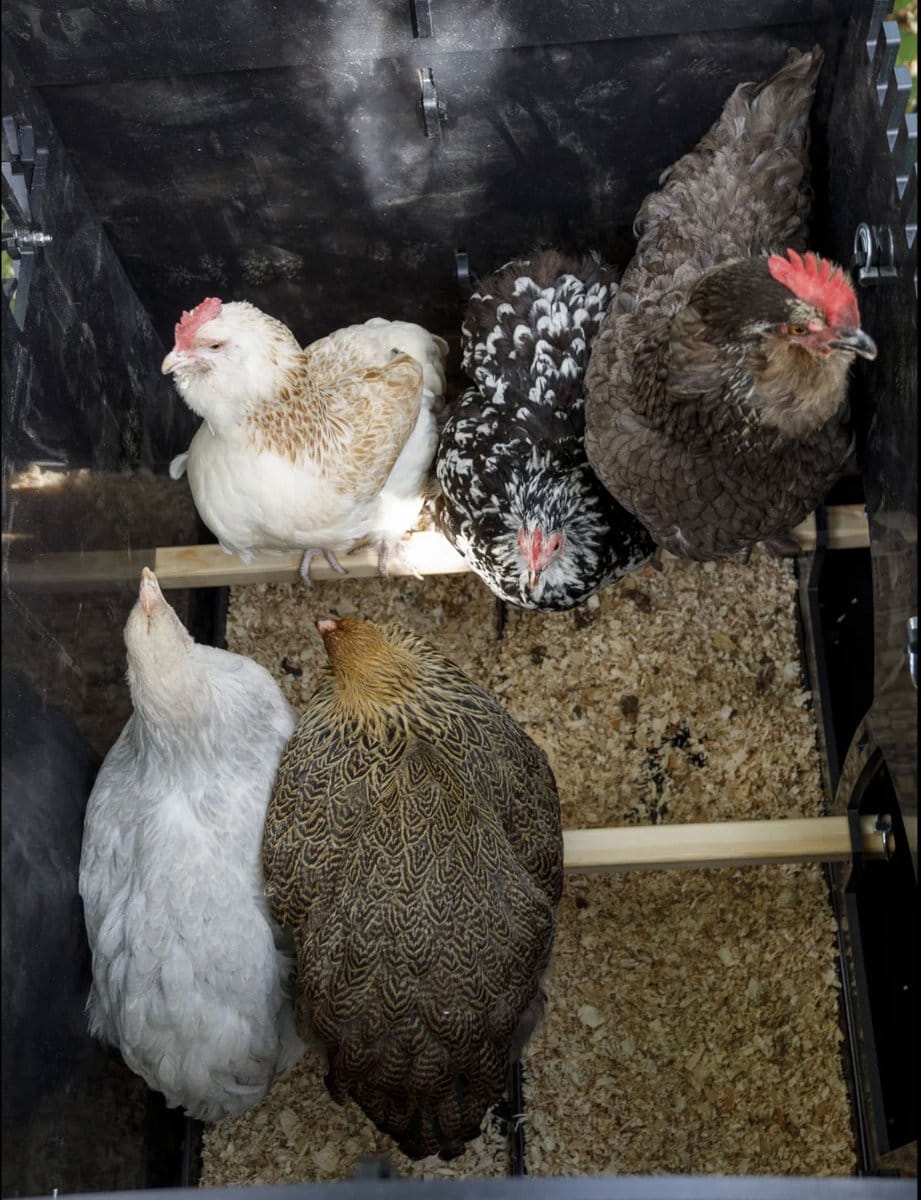
Lodge M kippenhok (kunststof)
Chicken coop made of 100% plastic for 5 to 9 chickens; easy to clean and weather-resistant.
Automatic chicken coop door – Nestera
Don't want to get up early every morning to let your chickens out? The Nestera Automatic Chicken Coop Door Opener offers the perfect solution.
The coop alone isn’t sufficient for a good resting place. The coop must be filled with e.g. sawdust (but not straw, as that retains moisture and absorbs less well) and must be replaced regularly. We recommend every 2-3 weeks, with four weeks as an absolute limit and with plenty of sawdust. In this respect you also want a coop whose side can be easily removed (as with these from Nestera). Then you only have to do that, brush through it, scatter fresh sawdust and Bob’s your uncle.
Finally keep a separate spot in the coop for the eggs – preferably also a place you can easily access. Again this is cleverly arranged with Nestera, with a removable side roof. Place a few golf balls or fake eggs in this spot. Then the chickens know where to brood. A table tennis ball can also work if you haven’t got anything else, but even a white roundish pebble can serve.
Natural enemies: foxes, martens, red mites and scaly leg mites
Unfortunately you’re not the only one interested in your chickens. Depending on where you live, Mr and/or Mrs Fox may be lying in wait. The same applies to martens. All sorts of systems exist to deter these. Think of ultrasonic sound, fake images of dogs, scent products… But from experience we know: these don’t work very well.
There are two reliable means of keeping foxes away from your chickens. A dog that’s very nearby and preferably of some respectable size. Or… a complete enclosure. You can achieve that complete enclosure in two ways. Either you put a run around your coop/shelter. Important here: this run absolutely must have an anti-tunnelling system. That’s extra reinforced mesh at the bottom of the coop towards the outside that you can bury. Foxes and martens can dig under the run to still bite your chickens to death. Both Nestera and Omlet offer options. With that extra mesh however the predators constantly encounter galvanised steel. But here too the same applies as for a decent plastic coop: it’s not cheap.
A final enemy are red mites and scaly leg mites. Here prevention is better than cure. Keep the coop dry and clean it out regularly. And therefore choose a plastic coop over a wooden coop. Do you still have them? Then in the case of red mites you must completely empty the coop and clean it with a pressure washer. You can also deploy predatory mites. They eat red mites.
Do your chickens have scaly leg mites? Dry their legs and coat them with ordinary Vaseline. Do the same with their perches.