You’ve read up on chickens. You’d like your own eggs. Or perhaps you’d like to rear your own meat. Or you simply enjoy seeing the creatures wandering about your garden. In a previous article we went into detail about how best to approach this. Which coop to use, which feed and care, which food… Today we’re covering the pitfalls: the things few people think about and some alternatives. Did you know, for example, that goose eggs are not only very tasty, but even more nutritious? And geese can live up to 30 years and guard your property?
We’ve already mentioned it: chickens can be very versatile. They’re good against insects, worms and slugs. They eat your leftovers and they can provide you with eggs and meat. Most organs of the chicken (except the intestines and gall bladder) can also be eaten. But you’d do well not to think too romantically about it. Chickens are ultimately farm animals and every farm requires work.
So it’s not the case that you can buy some chickens and then no longer need to look after them.
Financial
A first misconception is the financial aspect. Half a dozen eggs – from the ethical brand Kipster no less – costs €1.99 at Lidl. That’s roughly the ‘benchmark’, because eggs from your garden chickens are super-ethical, but also because you can never match the industrial scale of a large free-range farm, let alone a battery farm. That’s where the very cheap eggs come from.
But even if we compare Kipster’s eggs, we arrive at 33 eurocents per egg. That means that – after a not unrealistic investment of 1,000 euros in a coop, feed, care, the chickens themselves, fencing… – you’d have to squeeze no less than 3,000 eggs from your garden before you break even. Realistically, that’s 4-6 years of waiting. The average life expectancy of a chicken is 5-10 years. In the best case, you’ll just about get your money back, nothing more.
But, if you do have more eggs than you can eat yourself, you can legally and tax-free ‘monetise’ this. With an ‘honesty box’, you can sell each half dozen ‘surplus’ eggs for, say, €2. Simply create a QR code for Payconiq or PayPal, laminate it, hang it in, for example, a plastic garden box or cool box and Bob’s your uncle. You can also add or hang a charming chalkboard where you advertise the price and product. Mind you: you won’t get rich from this either: the payback time is similar, only this time you get money for your surplus eggs instead of giving them away to friends and family.
Practical
Chickens aren’t very clever. And they really can’t look after themselves. That means they need water as fresh as possible every day, on top of providing food every day, of course. We’ve already covered which food, but it means daily care. Moreover, you’ll want to see them cooped up every evening if you live where foxes and martens also live. Without an automatic (solar) door, that’s already a small task twice a day. Going away for a week or weekend? Then someone needs to come and look after them.
Chickens – especially if you add a cockerel for breeding – can also make quite a bit of noise. They cluck regularly and depending on how agreeable your neighbour is, this could cause you problems.
Then there’s the chicken manure – which naturally attracts flies. The coop itself also needs to be cleaned out every three to two weeks, which comes on top of the daily workload. So also ensure you have sufficient sawdust (and preferably not straw, as already mentioned).
Lodge M kippenhok (kunststof)
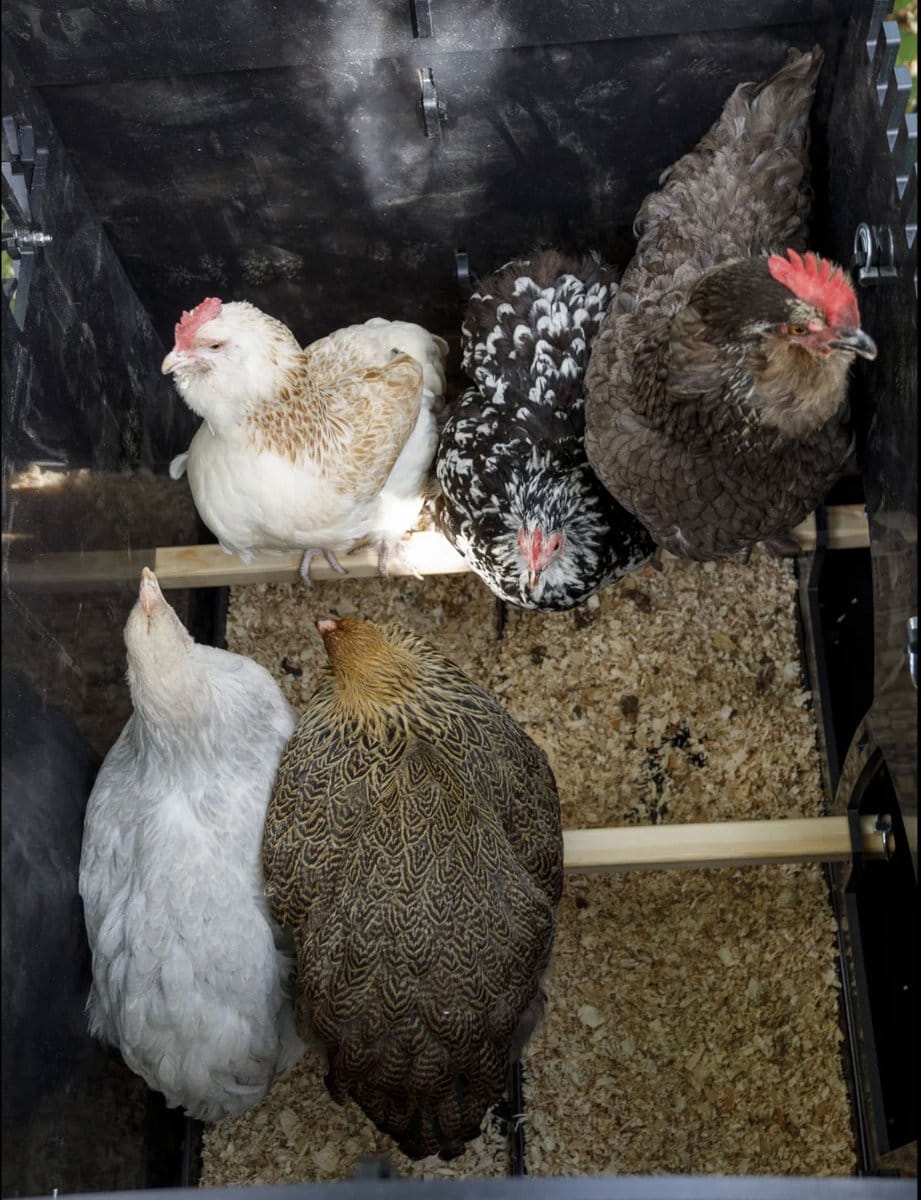
Chicken coop made of 100% plastic for 5 to 9 chickens; easy to clean and weather-resistant.
Automatic chicken coop door – Nestera
Don't want to get up early every morning to let your chickens out? The Nestera Automatic Chicken Coop Door Opener offers the perfect solution.
Biology and death
Chickens don’t continuously lay the same number of eggs either. Every autumn chickens moult: they lose their feathers and lay little or nothing for 4 to 8 weeks. A beginner chicken keeper is often startled by this and thinks the chickens are ill, but this is part of the story.
Chickens can also become genuinely ill. When there’s an increased bird flu risk, the government can impose a housing requirement. That means your feathered friends must be kept in the coop, or the run must be completely covered. If you don’t have that, you may not be legally compliant. The FASFC always communicates the current situation and usually, of course, there’s no housing requirement. However, the current measures were only recently (April 2026) relaxed.
But there’s more than bird flu (Newcastle disease, coccidiosis, respiratory infections…) – just as humans can become ill with all sorts of things. Your chickens sleep in one coop and can thus infect each other. A quarantine run is neither profitable nor useful for a small private keeper – so you could potentially lose all your chickens in a short time and have to start again.
Chickens can die from the aforementioned diseases, but also from ‘old age’ or predators. In most Flemish municipalities you may bury a chicken in your own garden, but there are usually strict conditions around this. Do you suspect the chicken died of bird flu (sudden death of multiple birds)? Then don’t touch the animal, but report it via the Influenza line on 0800 99 777. Do you have many carcasses? Then Rendac can collect them. Usually, however, this isn’t necessary.
Finally, chickens have a strict pecking order built into their genetic-evolutionary makeup. That means not only that you should buy three at once, but also that if you want new chickens you must add more than one. Otherwise the newcomer will be seriously bullied and even pecked bald. Therefore introduce the new chickens as a small group, and moreover preferably at night.
Alternatives
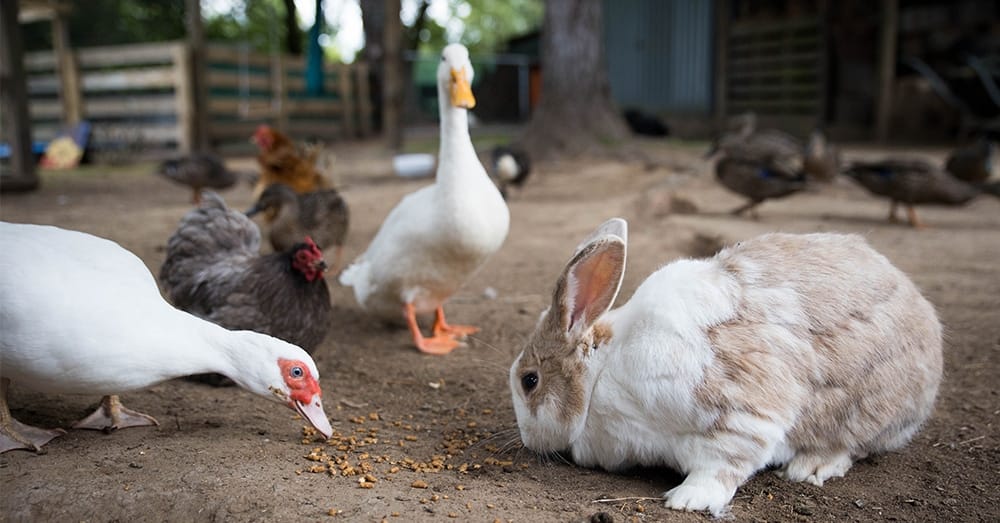
Do you absolutely have to have chickens? No, and there are quite a few alternatives. For example, there are ducks. They’re more robust than chickens and almost never ill. They catch slugs even better. They do require much more water. At least a large tub, and preferably even a small pond. They’ll also make that water very dirty very quickly. And their droppings are more ‘watery’ than those of chickens. Ducks also hide their eggs. So that’s also somewhat… inconvenient. Recommended breeds are obviously not park ducks, but the Khaki Campbell (top layer) or Indian Runner (upright/tall, good layer and they look quite amusing). They’re quite vulnerable and require the same protection from predators as chickens.
Then there are geese. These are excellent watchdogs. They make noise when strangers come onto the property and even attack unknown people. They also eat (a lot of) grass – you hardly need to supplement their feed. Moreover, they live much longer than chickens (up to 30 years even) and are a lot cleverer. They also become attached to their owner. On the other hand, they need a lot of space and are also not super clean (but cleaner than ducks). They also require less water – a bucket is actually ok. But a larger body of water where they can swim does make them happier. They don’t actually need a coop, a shelter suffices, which is an advantage – but that also means they are much more difficult to protect against predators. A fox can take on a goose, but will have trouble with it. The Emden geese are more intimidating in that case than the calmer Toulouse geese. In any case: they don’t hide their eggs and their eggs are more nutritious per gram than those of a chicken (due to a higher yolk-white ratio). But geese don’t lay eggs after May and before February… For a The Patriot enthusiast, the goose is in any case very versatile and perhaps even more suitable than the ordinary chicken – or at least a good addition. A watchdog, lawnmower and egg factory in one animal? Handy, isn’t it?
Finally, there are turkeys. These are heavy creatures, which are in fact mainly kept for their meat. Their eggs are, however, flavourful and larger than those of chickens. They are, however, if possible even more stupid than chickens and can, besides predators, easily die from the most banal causes such as drowning in their own water bowl (therefore put large stones in it, for example). They also need more space and larger coops. They are also susceptible to blackhead disease (histomoniasis), especially if they are kept together with chickens (combining is therefore not advisable). Finally, they make more noise. Therefore more interesting as a meat source and then it requires some specialisation and scale before it becomes more interesting than buying turkey from your butcher or supermarket.
Still want to go ahead? Absolutely possible!
In short: is poultry interesting? It certainly can be. It provides food security during price spikes, shortages or crises. Moreover, you monitor the quality yourself. You know what a pleasant life your chickens have and you know what they eat – and therefore don’t get any (chemical) rubbish.
Poultry recycles your food scraps and organic waste itself and removes slugs, mosquito larvae and other insects.
Moreover, you can teach children something with it: affection and care for animals, but also about the cycle of life and death (and where food really comes from). Eggs don’t grow on trees and neither does meat. But you knew that already, of course, after reading this two-part series.